
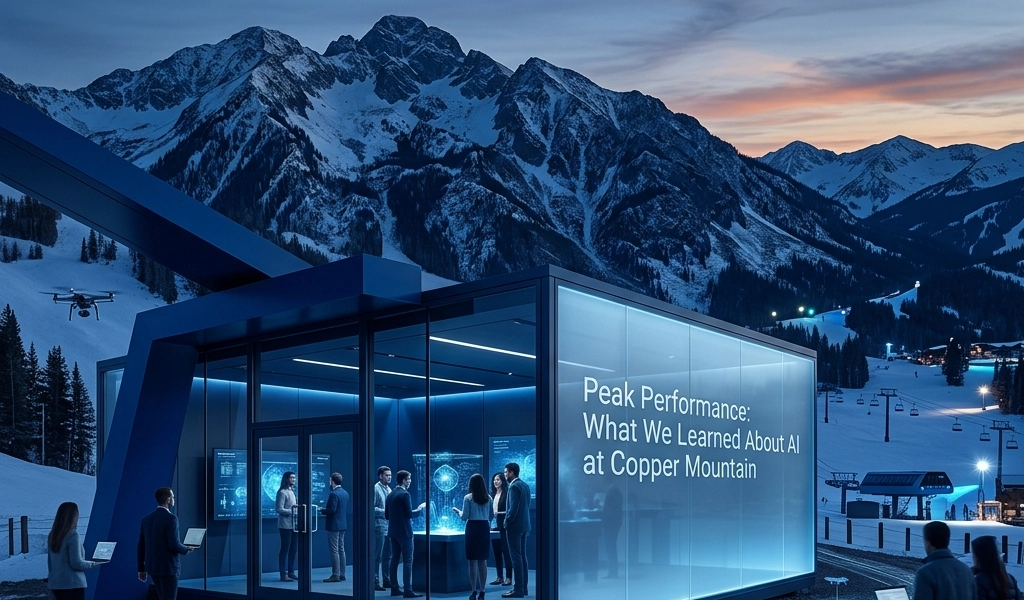
There is something about the crisp, thin air at 9,700 feet that tends to clear out the mental cobwebs. Earlier this month, the Zoller Consulting team headed up to Copper Mountain, Colorado, for the OTG Consulting Sales Kickoff. While the scenery was spectacular, the real fireworks happened inside the conference rooms. We spent serious time with a panel of senior AI experts, digging into where this technology is actually going versus where the marketing departments wish it were going.
If you have been following the news lately, you might think AI is either going to save the world by Tuesday or replace every human worker by Friday. The reality we discussed at Copper Mountain was a lot more useful and a lot less dramatic. The core theme was simple. AI works best when it helps people make better decisions, move faster, and spend less time buried in repetitive work.
That showed up again and again in the panel conversation. The discussion moved beyond flashy demos and into practical business value. The best insights were not about chasing the newest model. They were about using AI to improve outcomes, reduce noise, and give teams better visibility into what is really happening across the business.
Turn AI Into Better Outcomes, Not Just Faster Tasks
For decades, the promise of IT Consulting and new technology was speed. We got faster at typing, faster at sending mail, and faster at crunching numbers. But fast does not automatically mean valuable. One of the biggest takeaways from the Copper Mountain panel was that businesses are moving away from task-based workflows and toward intent-driven orchestration.
That sounds technical, but the business meaning is straightforward. In the old model, you told software to complete a series of narrow steps. In the new model, you give AI an objective and let it reason through the best way to get there. Instead of telling the system exactly which trail to take down the mountain, you tell it to get the team safely to the lodge with the best possible time and the fewest wipeouts.
Chris Willis of Mantix4 added an important reality check to that conversation. He talked about the AI FOMO that is pushing a lot of companies to rush in before they know what problem they are actually trying to solve. That pressure is real, but it often leads to wasted pilots, scattered tools, and executive frustration instead of better outcomes.
He also described what he called the jagged frontier. AI can look brilliant on simple tasks like writing a poem or summarizing a document, then fall apart when strategy, context, or business nuance enters the picture. That is a useful reminder for leaders. Just because a model performs well in a demo does not mean it is ready to make high-stakes decisions without guardrails, context, and human judgment.
The panel also talked about a shift from model-centric AI to outcome-centric AI. That is a healthy change. Most business leaders do not need a PhD-level debate about which model is trendier this week. They need to know whether the tool helps close deals, improve service, reduce risk, or make the operation more efficient. If the outcome is stronger, the model name matters a whole lot less.
Willis also emphasized that the real value is not just in the model itself. It comes from the orchestration around it and the infrastructure that supports it. In plain English, the magic is rarely the engine alone. It is the system around the engine that makes it useful, scalable, and efficient for real business work.
Think of it like a ski lift at Copper Mountain. You are not buying the lift because you love lift technology. You are using it because it gets you where you need to go with less wasted energy. That is what practical AI should do for a business. It should remove drag, streamline execution, and free your team to focus on judgment, creativity, and strategy.
See More, Hear More, Catch Problems Earlier
One of the most memorable moments from the panel came from Herman DeBoard of Ariez, who talked about what he called "Physical AI." His point was simple and pretty wild in the best way. AI is starting to give buildings and infrastructure something close to senses, including sight, smell, and hearing. That means a facility, a plant floor, or a grid asset can move from passive equipment to something more like an always-alert observer.
He shared a story from a transformer grid in Billings, Montana, that made the room sit up a little straighter. On day five, the AI picked up a high-pitched squeal coming from a busted seal. The interesting part was that it was not programmed to look for that exact issue. It detected the anomaly anyway. That is a strong example of where AI becomes more than automation. It starts functioning like a reasoning layer that notices what does not fit and flags it before a human team would normally catch it.
For business leaders, the benefit is not some futuristic robot-building fantasy. It is better visibility, earlier warnings, and fewer ugly surprises. If your systems can effectively see, hear, and recognize trouble sooner, you can reduce downtime, protect assets, and make more budget-friendly decisions before a small issue turns into a five-alarm mess.

Let Security and Operations Work as One Team
Another strong theme from Copper Mountain was how AI is now leading the charge in security and network detection. That matters because the same systems that look for threats are often spotting operational problems as a byproduct. In other words, if an AI platform is watching for suspicious behavior, it may also notice that a server is running hot, a CPU is overloaded, or traffic patterns look wrong long before users start calling the help desk in full panic mode.
That crossover is a big win for lean teams. It creates a more efficient and scalable way to monitor the environment without building separate towers of tools that never talk to each other. Security becomes more than a defensive function. It becomes a source of operational intelligence, which is a much better use of your budget and your people.
It would not be a pragmatic discussion without a few cautions. The hallucination problem is real, and the panel was clear about the danger of overestimating what these models can do today. Human oversight still matters. You would not let a self-driving car navigate a blizzard without someone in the driver’s seat, and you should not let AI create customer-facing contracts or technical specifications without expert review. The smart path is to use AI where it is strong while keeping experienced humans close enough to catch the weird stuff.
Build for the AI Era Without Falling for the Hype
If you have tried to look for AI solutions recently, you know the market is a chaotic mess of "AI-powered" everything. Every legacy provider suddenly sounds like it discovered religion at the same time and now wants credit for being born in the cloud. That is why the panel kept coming back to architecture, not slogans.
Rob Enslow pointed to companies like Vonage as an example of what a real rebuild looks like. With microservices and major investment, including the Ericsson acquisition, the goal is to rebuild customer experience and CCaaS from the ground up for the AI era. That is a lot different from bolting a chatbot onto an aging platform and calling it transformation. It is about creating a more scalable, efficient foundation that can support reasoning, orchestration, and smarter customer engagement over time.
This is also where vendor-neutral guidance matters. At Zoller Consulting, powered by OTG Consulting, we help business leaders compare real options and stay focused on outcomes instead of noise. OTG provides tailored technology solutions for mid-sized to large businesses through a vendor and carrier-neutral approach, with access to Hundreds of pre-vetted global providers and All major colocation facilities. That gives us room to evaluate what is practical, budget-friendly, and designed for your needs instead of pushing whatever happens to be loudest in the market.
Create a Stronger Foundation Before the Next Storm Rolls In
You cannot run advanced AI on a crumbling network. One point the panel drove home is that AI is only as good as the infrastructure under it. If your network is outdated or your security posture has holes, adding AI just helps your problems happen faster and with more enthusiasm.
That is why the conversation kept landing on fundamentals. A modern foundation should be secure, scalable, and efficient enough to support new workloads without creating chaos in the process. Whether the discussion is about network infrastructure, SD-WAN, SASE, UCaaS, contact center, cloud, IoT, or mobility, the business goal stays the same. Build an environment that can support smarter operations, better customer experiences, and less day-to-day friction.
For AI-focused initiatives, that same principle carries over to otgai.ai. The point is not to chase shiny objects. The point is to put the right systems in place so AI can create measurable outcomes instead of expensive confusion.

Take Practical Next Steps Without Face-Planting Into the Snow
So, what should you do if you are feeling behind the AI curve? First, breathe. You do not need to rewrite your business plan by Monday morning. You do need a straightforward plan that connects AI to business outcomes.
- Find the friction. Look for repetitive work, slow handoffs, and decision bottlenecks that drain time and money.
- Define the intent. Do not start with a tool. Start with the objective you want AI to help achieve.
- Clean up the foundation. Messy data, weak security, and old infrastructure will make every AI project harder than it needs to be.
- Measure outcomes. Track results like speed, visibility, service quality, and risk reduction instead of counting how many tasks a bot completed.
- Keep humans in the loop. The goal is to empower your team, not send them off the mountain without a map.
The conversation at Copper Mountain confirmed that we are in a period of massive transition. The businesses that thrive will be the ones that use AI to streamline execution, strengthen visibility, and improve outcomes without getting hypnotized by the hype.
Looking Ahead
As we descended from the mountains and headed back to reality, the path forward felt a lot clearer. AI is a powerful force multiplier, but it works best when it is tied to business intent, solid infrastructure, and human judgment. The big lesson from Copper Mountain was not that every company needs more AI. It was that every company needs a smarter way to connect technology decisions to real outcomes.
If you are wondering how to integrate these tools without losing your mind or your budget, that is exactly where a vendor-neutral advisor can help. Zoller Consulting keeps the focus on practical, scalable, and efficient decisions that support the business instead of the hype cycle. We help business leaders compare real options, cut through noise, and move forward with more confidence and less guesswork.
For more insights on how we approach the evolving world of tech, you can check out our thoughts on AI and job security or learn more about our approach to AI security. You can also visit otgai.ai for more specific information on our AI initiatives.
Ray Zoller, President of Zoller Consulting, is an independent Broker/Advisor who helps businesses streamline their technology and maximize their ROI through thoughtful, vendor-neutral consulting.
Zoller Consulting, powered by OTG Consulting.
OTG provides tailored technology solutions for mid-sized to large businesses through a vendor and carrier-neutral approach, with access to Hundreds of pre-vetted global providers and All major colocation facilities. Services include AI, security, network infrastructure/SD-WAN/SASE, UCaaS, contact center, cloud, IoT, and mobility. The engagement process includes design, proposal (multi-quote), selection, implementation, support/monitoring, and ticket escalation.
Ready to talk technology?
Whether you're evaluating AI, cybersecurity, networking, or any business technology — Zoller Consulting can help you find the right solution without vendor bias.
Schedule a Free Consultation →